Rock
Raise + call
Make one half-pot raise and call every other Rock.
A Texas hold 'em variant featuring simultaneous betting.
No-limit hold ‘em is a great game but not beginner friendly or suitable for casual play at parties. Games can also drag on and on. This is the pickleball to hold ‘em’s tennis. Simpler, faster-paced, and more social.
Make one half-pot raise and call every other Rock.
Fold if anyone plays Rock. Otherwise, check for free.
Call all the Rocks. If there are none, check for free.
Rock doesn’t beat Scissors here. The gestures tell the table how you’re betting.
01 / What changes
Everyone chooses before seeing the other moves. Rock and Scissors commit you to staying in and paying the total bet; Paper folds to any raise.
Agree on an ante. Everyone puts that amount in the pot at the start of each hand. There are no small or big blinds.
Everyone still in chooses a gesture, then says “Rock, Paper, Scissors, Shoot!” and shows it at the same time. Your choice is final: you can’t switch to Paper after seeing how many players raised.
Shoot once pre-flop, once after the flop, once after the turn, and once after the river. Everyone who reaches showdown must show their cards.
Use the pot size from before the shoot for every Rock. Recalculate only on the next street.
| Your move | Nobody plays Rock | At least one Rock |
|---|---|---|
| Rock | Impossible: your Rock counts | Stay in and pay for every Rock, including yours |
| Paper | Check and stay in for free | Fold; add no chips this street |
| Scissors | Check and stay in for free | Stay in and pay the same total as the raisers |
For example, with 20 in the pot, each Rock is 10. If two players choose Rock, one chooses Scissors, and one chooses Paper, the three players staying in each add 20. Paper folds. The new pot is 20 + 20 + 20 + 20 = 80.
Once the bet is paid, deal the next street. There are no follow-up raises or extra betting turns. If the river’s shoot leaves more than one player, go to showdown.
02 / An example hand
A, B, C and D are playing with a 1-chip ante. Step through their bets to see how the pot changes.
A, B, C and D ante 1 chip each instead of posting blinds. The starting pot is 4.
Payments are for this street only.
A wins on the turn, so there’s no river to deal.
03 / Practice
You and three bots start with 1,000 chips each. Click Rock, Paper, or Scissors to play. After everyone’s moves are shown, the game deals the next street for you.
Questions
A couple of edge cases, plus how this practice game handles stacks and bots.
With 20 in the pot, each Rock raises by 10. If three players choose Rock, everyone who stays in pays 30, including the raisers. Anyone who chose Paper folds.
Round down. With 15 in the pot, each Rock raises by 7. Two Rocks would cost 14 per player. Use the pot size from before this street’s bets.
The original rules don’t cover all-ins. Here, bets are capped at each player’s stack, with the usual side pots and refunds for uncalled bets. Once you’re all-in, you stop making gestures.
If fewer than two players have chips left to bet, the game runs out the board. When a split leaves an odd chip, it goes clockwise from the dealer.
You can refill to 1,000 when you bust. Bots do the same automatically between hands. The ante is 10, or whatever you have left if it’s less than that. Choose New table to start everyone over at 1,000. It’s all play money.
Lucky, Velvet and Nova can see their own cards and the board. They estimate their chances, weigh those against the cost of calling, and sometimes take a chance. Their moves are already chosen when you click. They can’t see your cards or your choice. Your equity estimate assumes random opposing hands.
Agree on the ante and how you’ll handle all-ins before you start. Before each shoot, say the pot size and what one Rock costs. Then count the Rocks, collect the bets, and deal the next street.
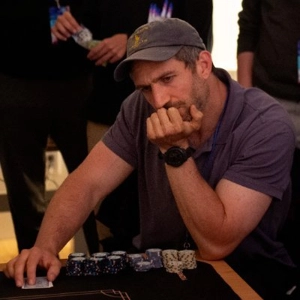
This game is dedicated to Max. Max was a friend, professional poker player, and RPS poker enthusiast. He tragically passed away in January 2025 at the age of 39.
My last interaction with him was playing this game. He was winning like usual.